
Some large companies have seen a drop off in the number of website visits they are receiving. A lot of this is attributed to Google’s AI Overview – that thing that appears at the top of a lot of your Google searches. This little widget is even appearing before paid ads and is changing how many firms are approaching their marketing efforts.

Marketing goliath Hubspot noticed a dip of 140 million website visitors over a 12-month period. That’s some dip! The company put this down to how we as a species are evolving online and changing the way that we search for answers. In short, Google’s AI Overview. Years ago, it could be quite hard to find the information you were looking for. These days, there’s way too much information, and a lot of it is bollocks. Nevertheless, AI Overview is a microcosm in response to a request to search all the information about that subject that exists in Google.
AI Overview can be quite useful, certainly when buying online or answering a question, but it is having an impact on how far people will go with their enquiry. In many cases, not very far and they’re stopping at the overview, which can be a bad thing for the person browsing as an AI Overview is not a full enquiry and can be wrong (as covered in the last article), but also for businesses who are now seeing that website visits are reducing. Search results that include AI Overviews can result in a reduction in click throughs to websites by as much as 70%. Many companies are now addressing this and adapting to these AI search facilities.
I did a test. I Googled ‘who is the best web design company in Liverpool’ to see what would happen. Surprisingly, we are mentioned, amongst others – I’m not surprised that we’re regarded as one of the best (obviously, we’re ace) but surprised because we haven’t done anything meaningful to optimise for AI search results yet.
As also covered in the last article, AI Overview can be manipulated for ill, but this is just another way of saying ‘optimised’. Indeed, AEO (answer engine optimisation) is the latest thing to help websites, or a website’s content, rank well in AI results such as AI Overview and ChatGPT. This is not a replacement for SEO as this is still important for AEO. But, understanding how AI search results are generated is important. For example, a Google search is generally quite short, for example, ‘tapas restaurant Liverpool’. AI searches tend to be longer and feature more words and more specificity, e.g. ‘tapas restaurant in Liverpool which specialises in Catalan food’. Each search brings up different results. A short-phrase Google search brings up the usual map links followed by the inevitable Tripadvisor top ten listing. The longer, more specific, search brings up an AI Overview with specific detail and with different results, as you can see below.
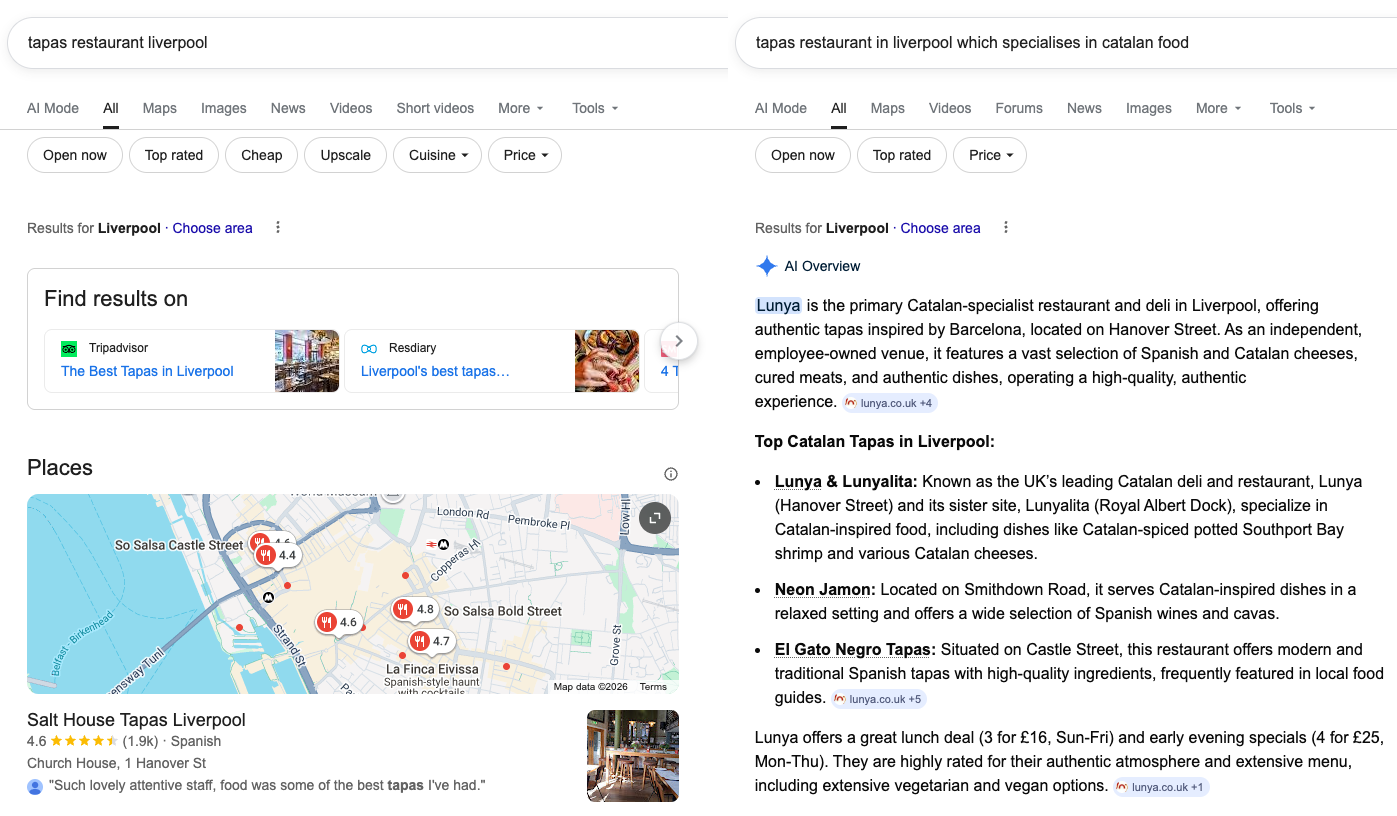
ChatGPT as a search engine is huge and people are using it for very precise search enquiries, for example, ‘Find me a hotel in a holiday resort on Spain’s Mediterranean coast that is fully inclusive and is close to some tourist attractions that are suitable for a family of five’. One would hope that this person would research further rather than just clicking the link on the AI search result, but you never know – people are funny. However, this is how people are searching now. So where are these answers coming from?
This is what it all comes down to. It always has. Organic SEO works if a website gives the most relevant answer to a user’s question. AEO works in a similar way, but with longer questions. Like effective content for SEO, ensuring that website content is well written, relevant, authentic, factually correct, answers a question, is genuinely useful, and reads naturally is an important approach. How it is written, or rather structured, is slightly different. While AI searches tend to be long, AI search results are short, so ensure content is written in smaller chunks, that’s clear and concise, that AI can easily extract and include in that little box at the top of Google. If your website content is generally pretty good, there’s no need to start over, but just address its structure, or write blogs or articles that lend themselves structurally to being used by AI.
Another area where AEO and SEO overlap is authority – been seen as an expert. A lot of retail companies are now publishing ‘content clusters’ (For God’s sake! Who comes up with these terms?) demonstrating their knowledge about a certain subject specifically structured for AI. Content clusters are a series of articles, or pages, about a subject that expand on elements covered more briefly in a central ‘pillar page’. These could be articles about sustainable forestry for a builders’ merchant, a history of black pudding for a butchers, a guide on how to fit a carpet for a flooring company, or a top ten article of the most iconic trainers for a sports outlet. AI loves this kind of thing, and it’s also beneficial for good old SEO. And, there’s literally aways something to write about, but it still comes down to being able to write – Chat GPT won’t do it for you with any authenticity. Sorry.
This approach by marketers is a shift away from optimising product pages to addressing people’s growing propensity for research and decision making before a purchase. It doesn’t mean that SEO is out of the window as this is still important. Having a Google-friendly website is vital if you want AI to visit your content and scrape it for an overview. Domain authority, reputation, well-built and greasy-quick sites, good rankings, high-visitor stats, and backlinks from other good-quality websites are needed if your AI-geared content is going to be used in AI results. If you don’t have these things, AEO is a waste of time and/or money – people won’t use a shit website, and neither will AI.
I mentioned above that we haven’t done anything meaningful for AEO but still appear in results. In all honesty, we rank in the top three on Google for various ‘web design Liverpool’ search permutations and have done for years. This has been down to having a well-built website, useful and well-written content, and plenty of visits rather than any sustained SEO campaign or Google Ads, neither of which we’ve ever done despite being ‘up there’. We’ve always blogged in which we’ve always answered clients’ questions. We’ve always given advice, and we’ve always written guides and ‘how tos’. However, changing how certain content is structured is something we’ll be addressing going forward. Evolve or die, unfortunately.
(Also, is it just me? Whenever I see ‘AI’ written down, I think, “Who’s Al?” (If you’ll be my bodyguard, I can be your long-lost pal…)
Author: Rich
